History
Maine Coastal Islands National Wildlife Refuge provides nesting places for a diverse assemblage of seabirds, amongst other fish, animals, and migratory birds. Most seabirds spend much of their lives on the ocean, returning to land only once a year to nest. Seabird survival depends on suitable nesting habitat. Continuing loss of nesting habitat, increasing nesting and habitat disturbance from recreational activities, growing coastal real estate development pressure, and competition from expanding gull populations all cause stress on seabird populations. FOMCI is committed to helping U.S. Fish and Wildlife Service in their protection of migratory birds and colonial nesting seabirds.
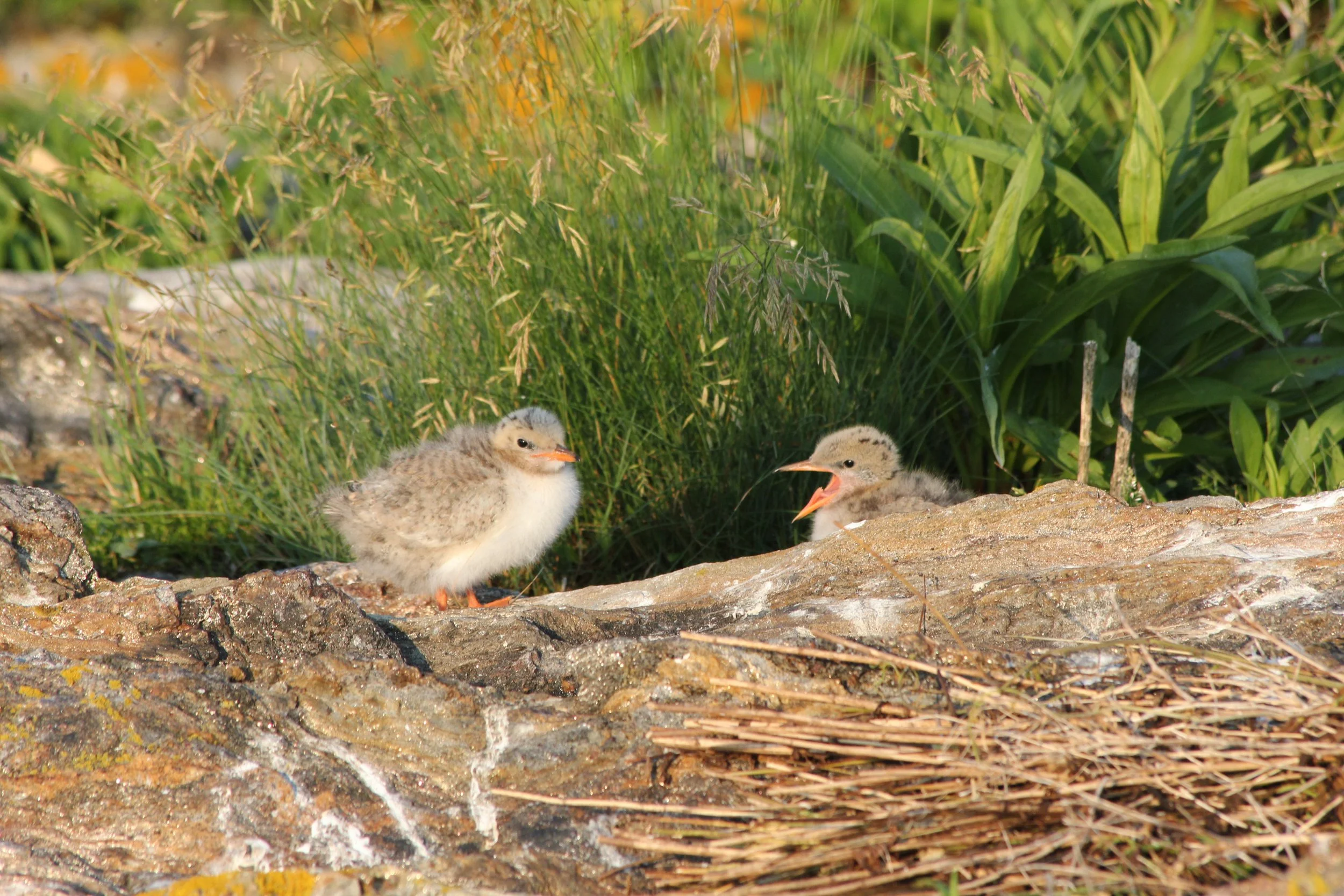
MCINWR manages seabird colonies on six of the islands in the Refuge. These six islands now support:
Nearly 90% of the Atlantic Puffins and Razorbills breeding in the US
97% of the Arctic Terns breeding in the lower 48 states
44% of the Common Terns breeding in Maine
The only colony of breeding Manx Shearwaters in the lower 48 states
The same islands also support sizable populations of Common Eiders, Black Guillemots and Leach’s Storm-Petrels
The Importance of the Islands
Of the 4,617 coastal islands in Maine, 377 have been designated by the U.S. Fish and Wildlife Service as nationally significant seabird nesting islands. Thanks to the hard work of private groups such as the Nature Conservancy and the Maine Coast Heritage Trust and others, conservation-minded individuals, and agencies such as the Fish and Wildlife Service, Maine Department of Inland Fisheries and Wildlife and Maine Department of Conservation, there is some form of federal, state, or private protection for 226 of these nesting islands. But the remaining 151 islands are under increasing pressure from coastal development and recreational uses.
Seabirds have relied on Maine‘s coastal islands for laying eggs and raising their young for thousands of years. Generally, the islands used by seabirds are small, treeless, rocky islands that provide a place free from mammalian predators such as fox, mink, and raccoon. Flying distance from the mainland often discourages avian predators such as Great Horned Owls and Peregrine Falcons. The cold waters surrounding the islands hold an abundant supply of fish and invertebrates for seabirds to eat.
Some seabird species nesting in Maine are no longer able to survive without direct human intervention. Biologists have been working since the mid-1970s to reintroduce and restore terns and puffins to former nesting islands along the Maine coast. Their successful efforts have also benefited nesting populations of Laughing Gulls, Black Guillemots, Razorbills, Leach’s Storm-Petrels and Common Eiders.
Island History
Native people used the coast’s natural resources for more than 5,000 years. Both pre-Algonquian cultures (“Red Paint People”) and more recent Indian cultures were seafaring people, camping on offshore islands in the summer and fishing the adjacent bountiful ocean waters. Although they hunted seabirds and their eggs, the abundance of seabirds, as well as other food resources (such as fish, shellfish, waterfowl, seals and land mammals such as deer, moose and caribou) meant that no one species was over-harvested.
Europeans began settling the islands in the 1600s. As cities grew, coastal inhabitants turned to the rich fish stocks and bird colonies to feed the city dwellers. Seabirds, shorebirds and waterfowl were killed in any way possible: Fishermen spread fishnets over nesting burrows to capture adults and fledglings; market gunners killed birds by the thousands during migration.
However, not all islands were fully plundered of their nesting seabirds. Many of the lighthouse keepers on offshore islands protected certain species, especially terns and puffins. Why? They harvested their eggs, too, preserving them in isinglass for the winter. Since they valued the eggs as an annual protein source, they sustainably harvested them, ensuring a constant supply for the following year. They favored terns and puffins over gulls for one reason: gulls tend to roost on buildings, and the lightkeepers depended on their roofs to collect freshwater for household use. Gulls defecating on the roofs contaminated their freshwater supply, so the gulls were chased away or killed.
In the late 1800s, fashion trends of bedecking women’s hats with feathers, wings, and even dried bird heads posed a further severe threat to the birds’ existence. Egrets, herons, and terns were especially popular and, therefore, were the species most harmed by the trend. At the start of the 20th Century, most seabirds in the Gulf of Maine were on the brink of extirpation. Only a few puffins, terns and gulls remained.
Concern for the future of all birds led to the passing of the Migratory Bird Treaty Act in 1918. The Act protects migratory birds, their nests, and their eggs. Around the same time, trains and automobiles replaced boats as preferred forms of transportation. People relocated to the mainland, easing pressure on seabird habitat. Some seabird species, nearly eradicated in Maine by the end of the 19th century, recovered dramatically. While protected from the kind of large-scale post-colonial pillaging, seabird populations today continue to be threatened by human overfishing, habitat loss, and the warming climate.
Path to Restoration
The first task in re-establishing a colony is to make it safe for the birds to nest on their former breeding islands. In some cases, it is sufficient to maintain a human presence on the island to discourage nesting gulls. Small populations of gulls can be controlled through egg and nest destruction, pyrotechnics, and limited shooting. Larger gull populations were historically removed with an avicide. Petit Manan, Seal, Pond, and Ship islands were all restored using the avicide DRC-1339 to remove the nesting Black Backed and Herring Gulls. This is a difficult topic to present to the general public; hence it's rarely discussed. This practice allowed managers to quickly remove the breeding gulls. Continued gull harassment and nest destruction prevents new gulls from settling on the island.
If terns have recently nested on the island, they can quickly return to the site once the gulls are removed. Laughing Gull, Common Eider, Leach’s Storm-Petrel, Atlantic Puffin, Razorbill, and Black Guillemot may also colonize the islands once the larger gulls are removed. However, if terns have not nested on the island in decades, we use social attraction equipment to encourage them to return to the island. This process includes sound systems continuously playing the sounds of a tern or puffin colony and seabird decoys are scattered across the island. Social attraction has been shown to be highly effective in re-establishing seabird colonies on several islands within the Gulf of Maine. Steve Kress was instrumental in developing the use of decoys as social attraction and also for translocating puffins from Newfoundland to jump start the Seal Island puffin colony. These efforts would not have been possible had it not been for the Maine Coastal Island National Wildlife Refuge performing gull control on the islands to open up breeding space and eliminate the direct predation from gulls.
Formation of The Friends of Maine Coastal Islands
The Friends of Maine Coastal Islands National Wildlife Refuge (FOMCI) was founded as a 501(c)(3) non-profit organization in 2003. It is formerly known as the Friends of Maine Seabird Islands. As one of over 185 U.S. Fish and Wildlife Service (USFWS) “Friends” organizations around the country, our mission has been to support the Maine Coastal Islands National Wildlife Refuge (MCINWR) in its efforts to conserve, protect and enhance the rich diversity of coastal habitats, seabirds and other wildlife.
We focus on advocacy efforts, public outreach, volunteer management and fundraising to support our mission. Since most Refuge visitors have not been able to experience the seabird islands firsthand, the organization works to bring the seabirds to visitors through models and displays of seabird nesting islands, classroom exhibits, an art gallery and a theater where they are exposed to the sights and sounds of seabird nesting islands.
In recent years, our primary goal has been to raise funding to keep interns on Metinic Island, Petit Manan Island, and Ship Island. These hardworking interns are crucial in ensuring that the seabird colonies of coastal Maine endure.