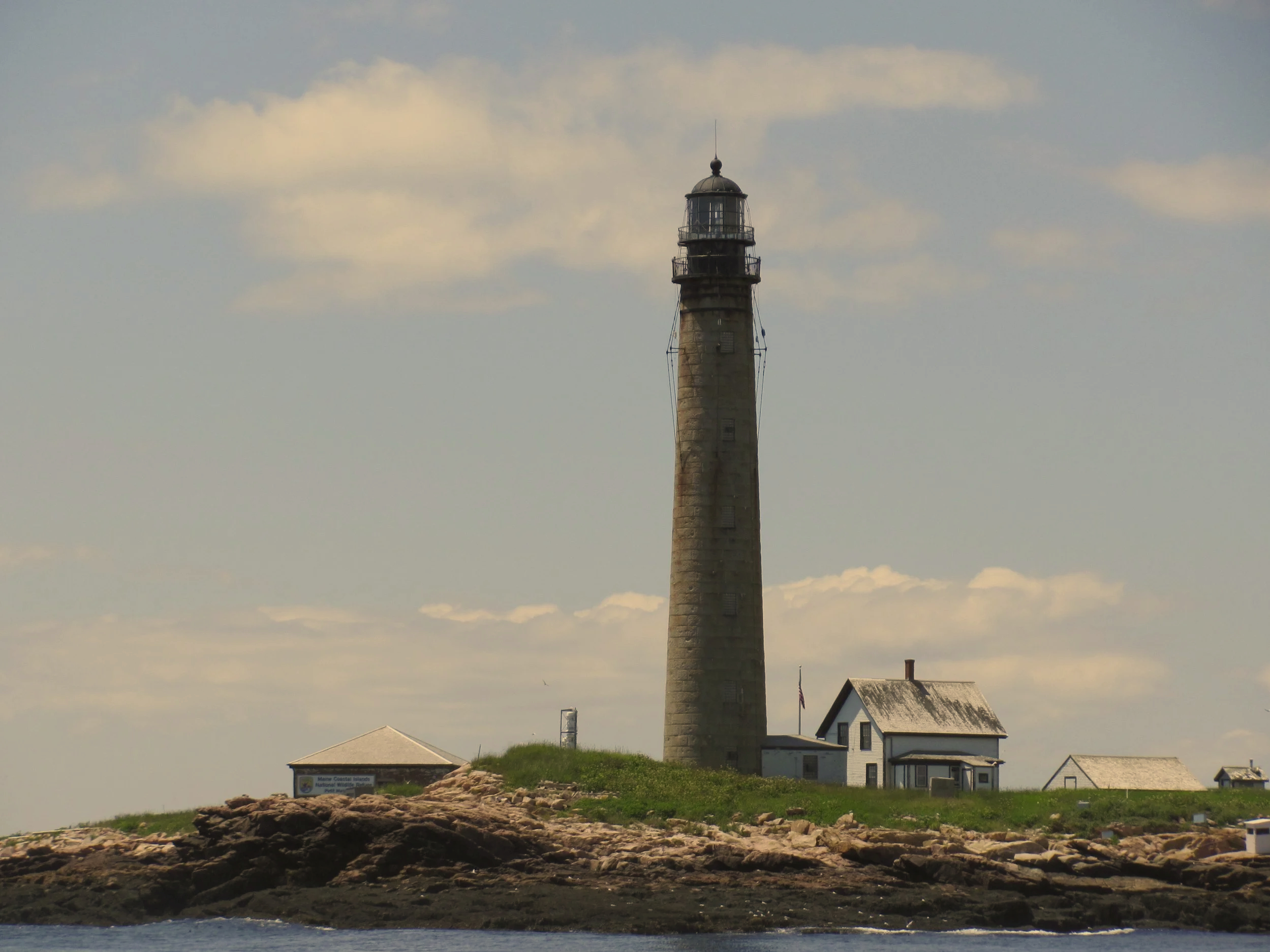
Petit Manan Island
This 10-acre island lies 2.5 miles south of Petit Manan Point in the Town of Steuben, Washington County. It was acquired in 1974 by transfer from the U.S. Coast Guard. The Coast Guard continues to maintain the lighthouse tower and navigational aids, and U.S. Fish and Wildlife Service maintains several historical structures. Petit Manan has long been considered one of the most important islands in the Gulf of Maine for colonial nesting seabirds.
Petit Manan Island is closed to public access during the seabird nesting season: April 1 to August 31. Informational signs alerting visitors to this closure are in place.
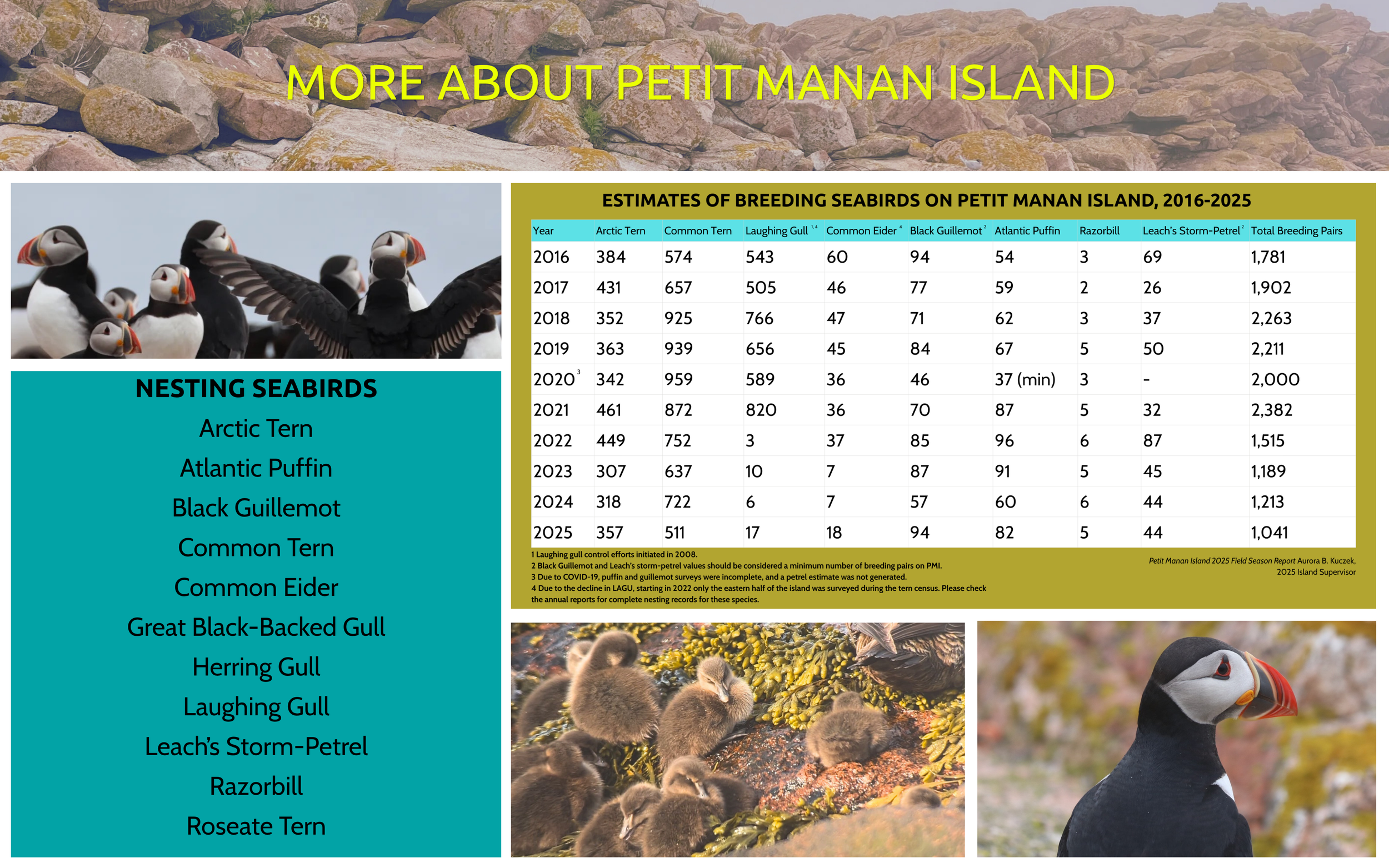
Nesting Seabirds on Petit Manan Island
Information provided by Petit Manan Island 2025 Field Report
Petit Manan Island is a 10-acre island located approximately 2.5 miles south of Petit Manan Point in Steuben, Maine. The U.S. Fish and Wildlife Service (USFWS) has owned and managed PMI since 1974 as part of the Maine Coastal Islands National Wildlife Refuge. PMI is connected to adjacent Green Island via a cobble tidal bar exposed an hour before and after high tide. Green 45 Island is owned and managed by Maine Department of Inland Fisheries and Wildlife (MDIFW).
Historically, PMI has served as an important nesting island for a variety of species, particularly Common (Sterna hirundo) and Arctic Terns (S. paradisaea). However, throughout the 1900s, tern populations experienced high rates of disturbance and predation by rapidly growing populations of Great Black-Backed Gull (Larus marinus) and Herring Gull (L. argentatus). By 1983, terns had completely abandoned PMI. To restore the PMI tern colony, USFWS initiated gull control efforts in 1984 as part of a coordinated seabird restoration effort in the Gulf of Maine. The terns began visiting the island within one week of the gull control efforts.
Other bird species have also benefited from USFWS predator control and tern restoration efforts, and the island now supports a diverse seabird colony. Seasonal technicians live on the island for 12-14 weeks each summer to monitor the seabirds, conduct research, and to deter both mammalian and avian predators. Predator control includes non-lethal methods (e.g., noise deterrents, lasers, human presence) and lethal tactics (e.g., adult removal and nest destruction). The territorial behavior of nesting terns also helps to keep some avian predators away from the island.
The USFWS manages the vegetation on the island through prescribed fire, invasive plant control, and mowing. Since 1984, the island has supported breeding populations of Arctic and Common Terns, federally endangered Roseate Tern (S. dougallii), Atlantic Puffin (Fratercula arctica), Razorbill (Alca torda), Black Guillemot (Cepphus grylle), Common Eider (Somateria mollissima), Leach’s Storm-Petrels (Hydrobates leucorhous), and Laughing Gulls (L. atricilla). Arctic Tern, Atlantic Puffin, and Razorbill are each listed as threatened by MDIFW while Leach’s Storm-Petrels are listed as a species of special concern.
BROWSE EBIRD LISTINGS
eBird is a platform that allows you to record and track bird sightings in real time! Each recording contributes to the Cornell Lab of Ornithology’s database helping to make more accurate statistical observations that impact conservation today!